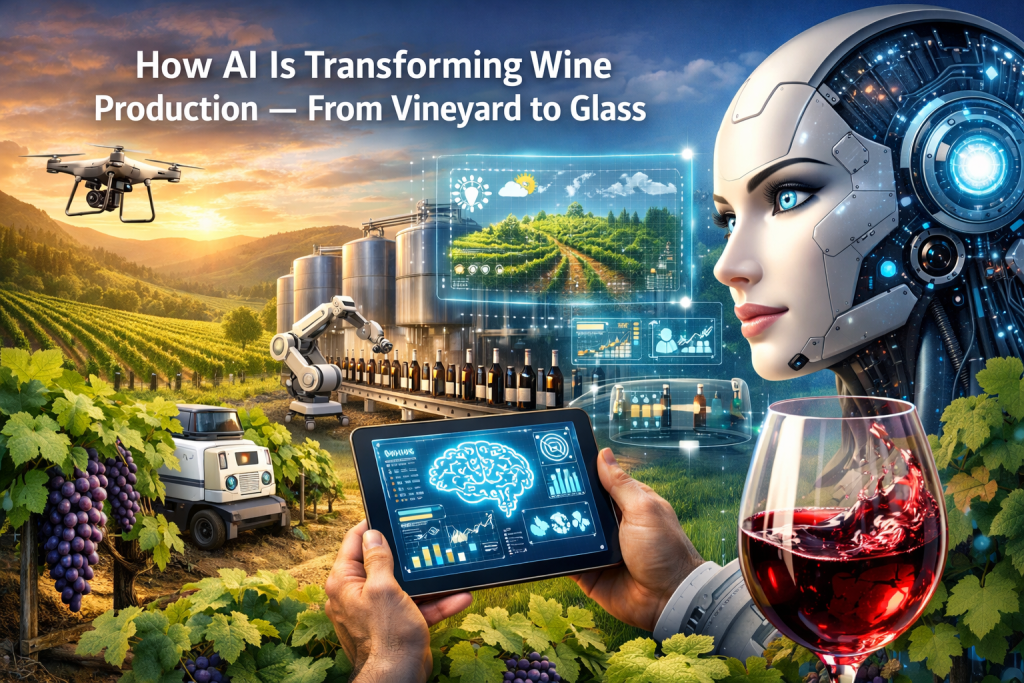
The wine industry has always blended tradition with innovation — and today, artificial intelligence is becoming one of the most powerful tools in a winemaker’s arsenal. From predicting the perfect harvest window to monitoring fermentation in real time, AI is helping wineries make smarter decisions at every stage of production.
Whether you manage a boutique estate or a large-scale operation, the good news is that most of these technologies are already practical, affordable, and built around the data you’re already collecting. In this post, we’ll explore the most promising ways AI can improve vineyard management, cellar operations, and sales — and how you can start applying them today.
AI applications across the wine production lifecycle
Realistic, data-driven ideas for improving quality and productivity at every stage — from vine to glass.
Vineyard intelligence
Soil analysis
Sensor networks map pH, nutrients, and moisture block-by-block, enabling precision fertilisation and reducing water use by 20–30%.
VineyardWeather forecasting
Hyperlocal frost, rain, and heat-spike alerts automatically trigger frost fans and irrigation systems before damage occurs.
VineyardDisease detection
Drone and camera imagery detects powdery mildew and botrytis early, enabling targeted treatment instead of blanket spraying.
VineyardHarvest optimisation
Harvest timing model
Brix, pH, and anthocyanin readings combined with weather forecasts predict the optimal pick window per varietal and block.
HarvestYield prediction
Computer vision cluster-counting at véraison delivers reliable tonnage estimates 8 weeks before harvest for better logistics planning.
HarvestLabour scheduling
Predicted tonnage and harvest window data drive automated crew and equipment deployment plans, reducing idle time and overtime costs.
HarvestCellar & fermentation
Fermentation control
Temperature, Brix, and CO₂ sensors feed an ML model that adjusts cooling jackets in real time to hit target flavour and style profiles.
CellarPredictive maintenance
Vibration and temperature sensors on pumps and presses flag failures before they happen — critical during crush when downtime is most costly.
CellarBlending assistant
Lab data and sensory scores train a model that suggests blend ratios to hit style targets, maintain vintage consistency, and reduce waste.
CellarSales & sustainability
Demand forecasting
Sales history, events, and review sentiment predict SKU demand by channel, helping reduce overstock and avoid costly write-offs.
SalesDTC personalisation
Wine club purchase history drives personalised recommendations and offers that improve reorder rates and average order value.
SalesWater & energy tracking
Automated dashboards monitor water use per gallon and energy per case produced — meeting sustainability certifications and export requirements.
SustainabilityVineyard intelligence
Soil sensors (EC, pH, moisture) placed across blocks feed a spatial map that lets you apply fertiliser and water only where needed — reducing input costs 20–30% in trials at precision-ag adopters. Weather prediction at the sub-kilometer level is now accessible via APIs (Tomorrow.io, DTN) and solves a real, recurring problem: frost events, heat spikes above 35°C, and unexpected rain near harvest are the three biggest yield threats. An AI alert system tied to your irrigation controllers and frost fans can respond faster than any manual process.
Harvest timing & yield
Computer vision running on drone imagery or even fixed camera rigs can count grape clusters at véraison and give you reliable tonnage estimates weeks before harvest — that’s the difference between scrambling for extra bins and scheduling labor intelligently. The harvest timing model is the highest-ROI application for most wineries: combining your own historical Brix-to-quality data with the season’s weather trajectory to suggest the optimal pick window by block and variety.
Fermentation & cellar
This is where IoT sensor data pays off most immediately. Continuous monitoring of fermentation tanks (temperature, residual sugar, volatile acidity, CO₂) allows a model to flag stuck fermentations or runaway heat events hours before they’d be caught by manual punch-downs. For predictive maintenance, vibration sensors on your must pump cost under $200 each and can predict bearing failures with days of warning — a pump failure during peak crush is a genuine crisis.
The blending assistant idea is particularly compelling: if you log your lab analyses and the sensory scores of finished wines, you accumulate a dataset that maps chemistry to taste outcomes. After two or three vintages, a model can suggest blend ratios to hit a specific style target or maintain consistency across years.
Commercial & sustainability
DTC is where most small wineries leave the most money on the table. A basic recommendation model on your wine club database — trained on purchase history and tasting notes — can drive meaningful lift in reorder rates. Water and energy tracking per case produced is increasingly required for export markets and certifications; an automated dashboard removes the manual reporting burden.
Realistic sequencing for a small-to-mid operation: Start with weather alerts + harvest timing (high impact, low integration cost), then fermentation monitoring (sensor hardware is inexpensive, ROI is immediate), then build toward the data assets needed for blending and DTC models as your datasets grow.
No Comments yet!